In the 1760s, the city of Edinburgh was the epicentre of the Scottish Enlightenment; a crucible of academic inspiration that fostered advancements in medicine, engineering, architecture, chemistry, philosophy, sociology, and economics. In America, Founding Fathers Thomas Jefferson and Benjamin Franklin both expressed their admiration for the city and its innovators and inventors, whilst the great French thinker Voltaire admitted that “we look to Scotland for all our ideas of civilisation”.
During this same period, Edinburgh also witnessed the first Golden Age of Scottish art represented by the fine portraiture of Allan Ramsey and Sir Henry Raeburn, the history paintings of Gavin Hamilton, and by a nascent school of Scottish landscape painting.
Edinburgh’s leading decorative arts studio at the time was that of the Norie Brothers whose artists painted panel pictures of romantic Highland scenes that decorated the interiors of the city’s Palladian villas. Due to its growing reputation as a “hotbed of genius” and to the neoclassical buildings that transformed the New Town, Edinburgh was dubbed “the Athens of the North”, but it was instead to Rome that its young artists looked most closely, and none more so than the Norie’s most gifted young apprentice, Jacob More.
 ‘Morning’ and ‘Evening’ by Jacob More (1785)
Image courtesy of Kelvingrove Art Gallery, Glasgow
Like Richard Wilson in Wales and Thomas Gainsborough in England, this young Scottish painter of “landskips” took inspiration from the 17th century French painter Claude Gellée – known to us today as Claude Lorrain. Although no individual can accurately be called “the father of landscape painting” Claude Lorrain was certainly one of the earliest progenitors who helped transform what had once been the humble backdrop of a prestigious figural composition into the principal focus and artistic point of a painting.
In his glowing pictures of Arcadia his priorities are clear; scenery and structures first, society a distant second. According to the Italian art historian Filippo Baldinucci, Claude would joke with clients that he charged his fee for the landscapes and gave the figures for free. Jacob More’s pictures further emphasise this focus upon places rather than people.
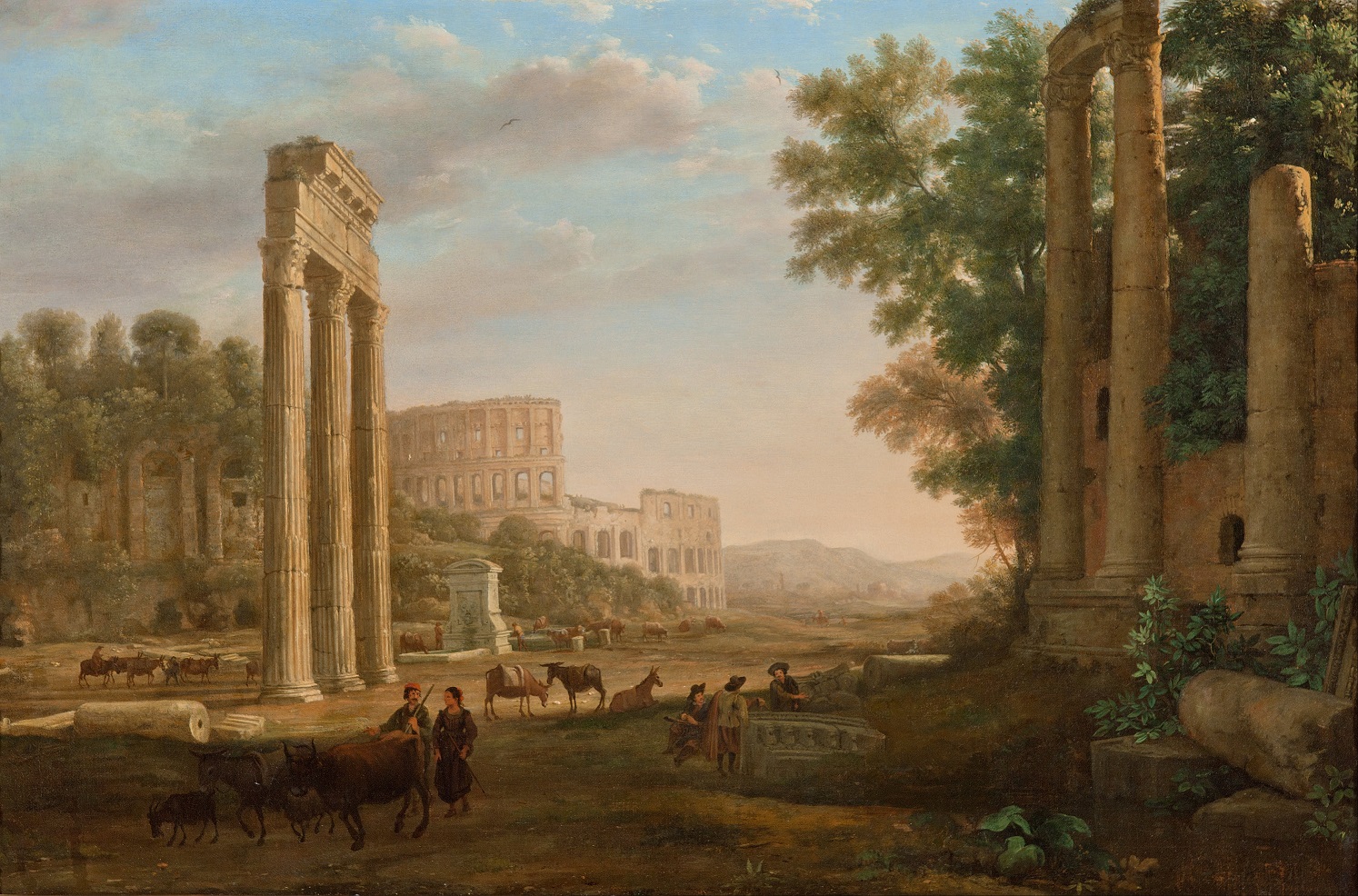 ‘Ruins of the Roman Forum’ by Claude Lorrain (circa 1634)
Despite attaching little importance to the entirely faithful representation of nature – as was then the norm – Jacob More was an enthusiastic sketcher and built up a considerable library of drawings and watercolours executed outdoors, directly from nature. Their principal purpose was not to make (anachronistic) Ruskinian studies of leaf and branch forms, but to capture vignettes of Sublime composition and lighting effects such as chiaroscuro and contre-jour. More’s watercolours show that he was a confident and rapid painter of the natural world, an ability that no doubt came in handy a few years later when making sketches of a volcanic eruption on Mount Vesuvius.
The culmination of the artist’s career in Scotland was a collection of oils depicting the ‘Falls of Clyde’, a series of three landscapes of linns (a waterfall above a pool) on the River Clyde; ‘Corra Linn’, ‘Bonington Linn’, and ‘Stonebyres Linn’. The 1857 publication (and subsequent popularity) of Edmund Burke’s ideas of the Sublime in nature had ushered in a new age of Romantic art and few sights better exemplify the awesome power of the natural world than a raging torrent.
 ‘The Falls of Clyde, Corra Linn’ by Jacob More (1771)
Image courtesy of the National Galleries of Scotland
When Jacob More moved south to London in 1771 to make his exhibition debut at the Society of Artists, ‘Corra Linn’ was purchased by Sir Joshua Reynolds, president of the Royal Academy and at that time the most influential figure in British art. Reynolds acquired several landscapes from More and was, according to the artist George Walker, “so pleased with them that he warmly recommended the artist to the notice of some of the nobility by whom he was afterwards employed.”
A thumbs-up from Sir Joshua was the greatest leg-up any young artist of the time could wish for and did indeed secure the young painter a string of aristocratic patrons.
During his stay in London, Jacob More took the opportunity to again follow the lead of his beau ideal Claude by becoming a scene painter in the West End. Like his great contemporary George Lambert – and later, Philip James de Loutherbourg and Clarkson Stanfield – he honed his draftsmanship and compositional skills designing vast backcloths for the Theatre Royal in Covent Garden.
In 1772, encouraged by his new patrons (and enabled by their financial support), More left England for the continent where he journeyed through the Papal States of central Italy to his ultimate destination, Rome.
For many Northern European painters in the Eternal City everyday life included daily visits to the city’s famous artist hangouts; the Antico Caffè Greco near the Spanish Steps and the Caffè degli Inglesi in the Piazza di Spagna and it was above the English coffee house that More set up a small studio. The cafe had been recently decorated with murals by the great Italian artist Giovanni Battista Piranesi (1720-1778) whose spectacular architectural drawings and etchings of Rome provided More with further inspiration and a greater familiarity with the works of other important Italian vedutisti such as Giuseppe Vasi, Marco Ricci, and Giovanni Paolo Panini.
From his base in the city Jacob More soon established himself as one of the foremost painters of “distant view” landscapes or lontananze (as they were known in Italy). His skilful interpretation of the fashionable theories of the sublime and picturesque – particularly the impact of light and shadow and the juxtaposition of serenity and grandeur – sold well to rich and famous clients on the Grand Tour, amongst whom he was held in the highest esteem. Upon visiting More in Rome, the German poets Goethe and Friedrich Leopold, Count of Stolberg became great admirers; the latter claiming that More “handles his pencil like a poet”. Lord Gardenstone, meanwhile, claimed to “have seen no rival to Mr. More as a landscape painter”, whilst Sir William Forbes believed More was not “excelled by any artist of the present day”.
Meanwhile, the paintings More sent back to London for exhibition further increased his reputation at home. In 1775, four of the artist’s Roman landscapes – two views of Lake Albani, the Road to Tivoli, and a Distant View of Rome at Sunset – were exhibited at the Society of Artists of Great Britain in London.
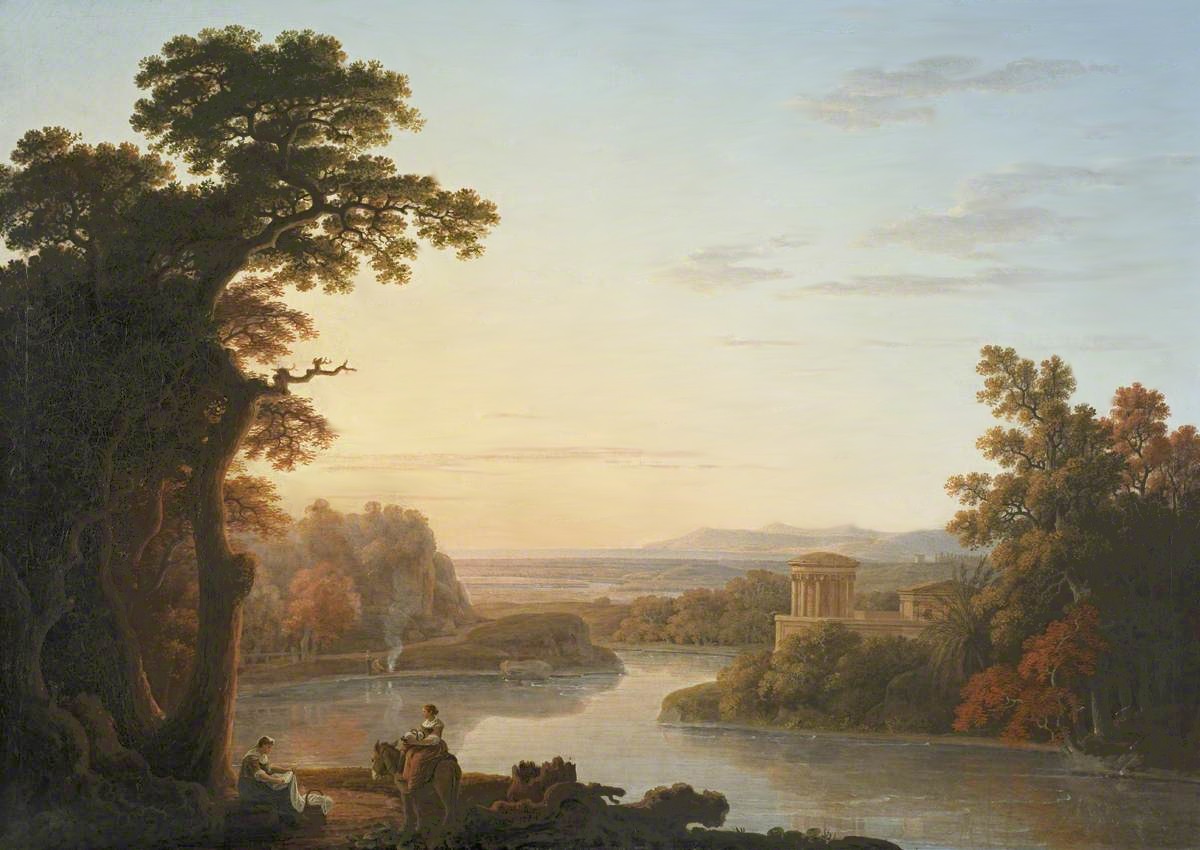 ‘The Tiber Estuary’ by Jacob More (1784)
Image courtesy of St. Catherine’s College, Cambridge University
Although Jacob More’s style evolved in Italy to encompass some representational elements he remained faithful to the decorative aesthetic; always more interested in the idyllic rather than the merely representative. And it was a formula that worked. As the Rome-based Scottish dealer James Irvine commented, “From a house painter in Edinburgh, More is become one of the first landscape painters that ever lived”.
In 1779, “More of Rome” added Earl-Bishop Frederick Hervey (aka Lord Bristol) to his list of important patrons. The Earl-Bishop was one of the most voracious art collectors of Georgian England and one of its most notoriously flamboyant and eccentric characters. What His Lordship wanted, His Lordship invariably got – and not only when it came to acquiring paintings.
Jacob More’s extensive connections in Rome led him to become the Earl-Bishop’s art advisor and virtual agent. In addition to supplying him with his own paintings, More was tasked with sourcing Old Masters, genuine examples of which were already becoming difficult to find. He also liaised with his friend, the eminent sculptor, Antonio Canova to purchase statuary for the Earl-Bishop’s numerous palatial residences.
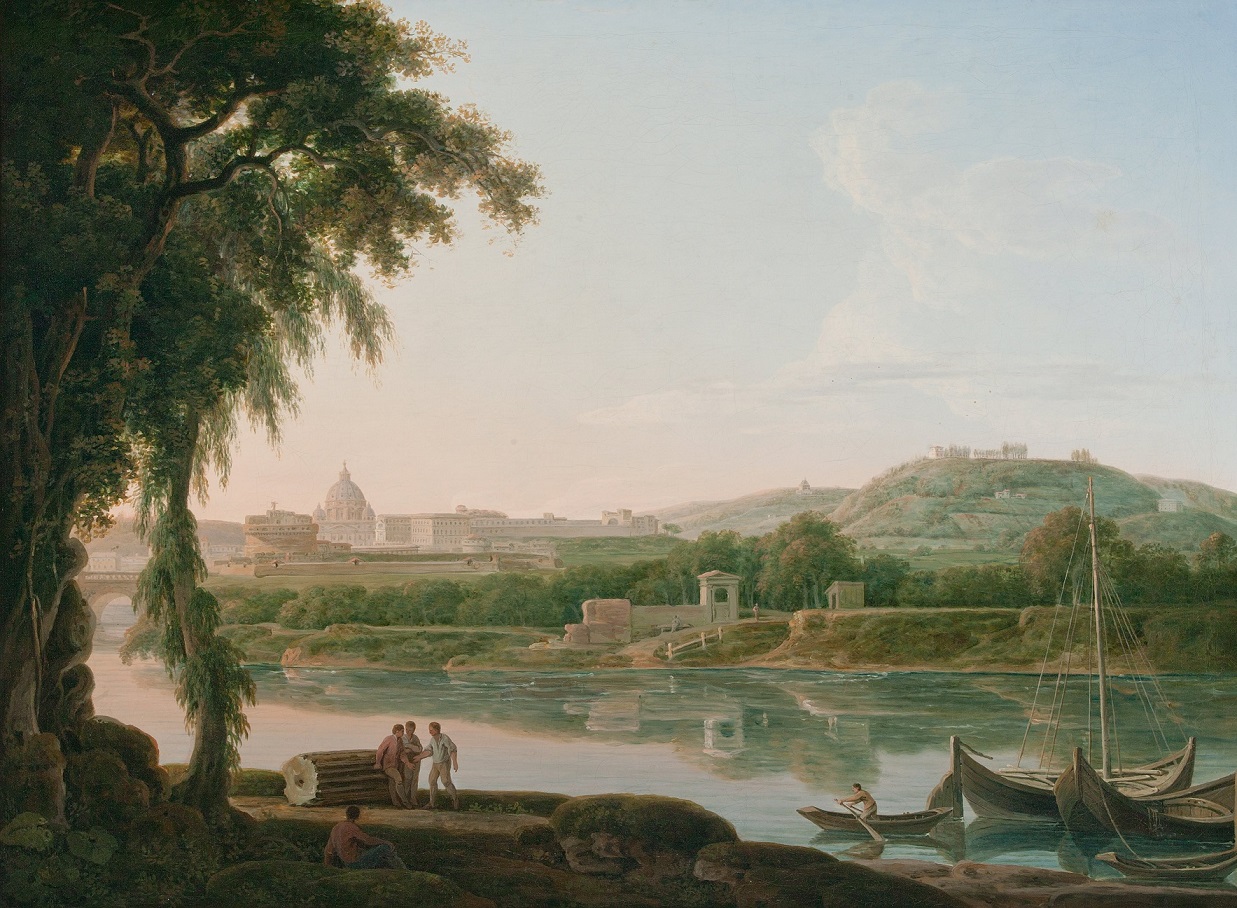 ‘A Distant View of Rome from the Tiber’ by Jacob More (1774)
Image courtesy of the Art Gallery of South Australia
In 1780, More was elected a member of the prestigious Accademia di San Luca, an honour that no doubt helped persuade Prince Marcantonio Borghese that here was an artist of sufficient stature to assist in the redecoration of the Villa Borghese, the pinnacle of Roman wealth and culture and, still to this day, one of the most visited sites in Italy.
The prince commissioned More to paint a huge 12-foot-high scene of Ovid’s ‘Metamorphoses’ specifically for the Stanza di Apollo e Dafne, the room in the villa that contained the world-famous statue of the same name carved by Gian Lorenzo Bernini in 1624. Borghese was so impressed by More’s artistic flair and impeccable taste that he engaged him to assist in the wider remodelling of the villa. Conventional wisdom has it that the Italian architect Antonio Asprucci “created the first example of an English landscape garden in Rome” but the famous lake and Giardino Inglese were in fact designed by Jacob More who, after all, had actually lived in England and knew what they looked like, unlike Asprucci who never left Italy.
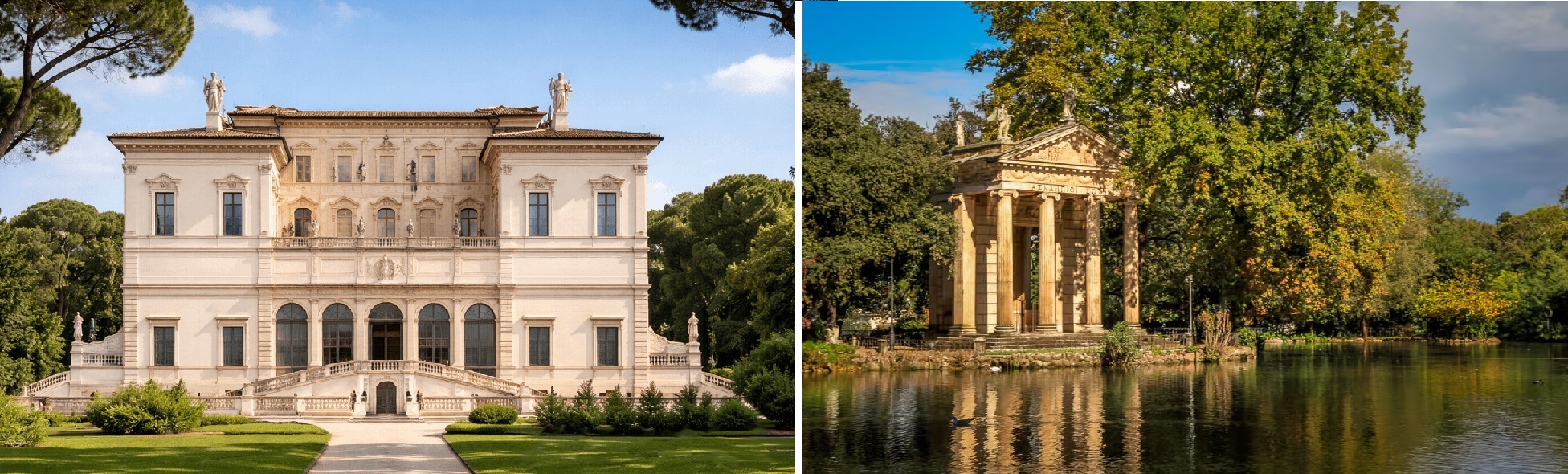 The Villa Borghese and its English Garden and Lake
Eventually – as so very often – the relationship between gauche patron and adroit painter became strained. According to another ex-pat dealer in Rome, Thomas Watkins, Jacob More “arranged everything to the greatest advantage but unfortunately the prince – who has not the least judgement in things of this nature – frequently interferes”.
More’s main artistic rival in Rome was Jacob Philipp Hackert, one of the many disciples of the influential French landscape painter Claude-Joseph Vernet. According to More’s friend, the artist Thomas Jones, it was More’s success in the city that prompted Hackert to move on to Naples where he won commissions from Sir William Hamilton for paintings of Vesuvius (see ‘Explosive Art in the Age of Reason’ at the News & Articles page). This didn’t stop More from also making the trip south where he too captured striking scenes of the city’s famous Mountain of Fire for Earl-Bishop Hervey.
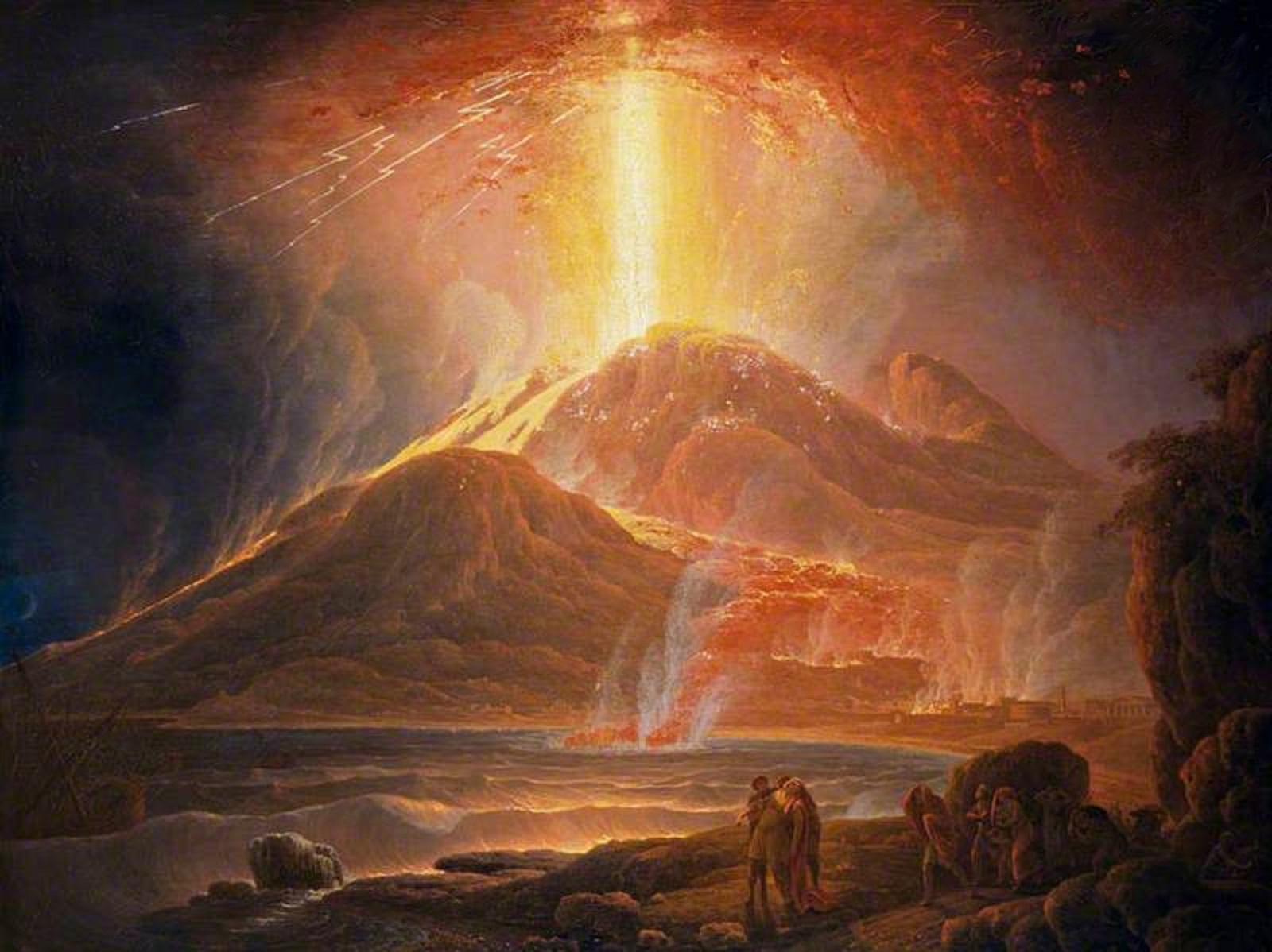 ‘An Eruption of Mount Vesuvius’ by Jacob More (1778)
Image courtesy of the National Galleries of Scotland
Jones recalled that More was on the slopes of Vesuvius in 1778 during an eruption “at least half a mile wide… More certainly seized the opportunity to record all he could, making ‘flying Sketches’ on a visit up the volcano at night”.
Well aware of the artistic and commercial opportunities presented by the cataclysmic, More travelled further south to Sicily where he painted at least two views of Mount Etna in eruption and to Umbria to paint the mighty Roman waterfall at Terni. But by and large his travels in Italy were centred in the region of Lazio where he painted views of the villa of Maecenas and Falls of Tivoli, the coastal town of Terracina, Bandusia Falls at Licenza, views of the Campagna, and the Castel Gandolfo on Lake Albano.
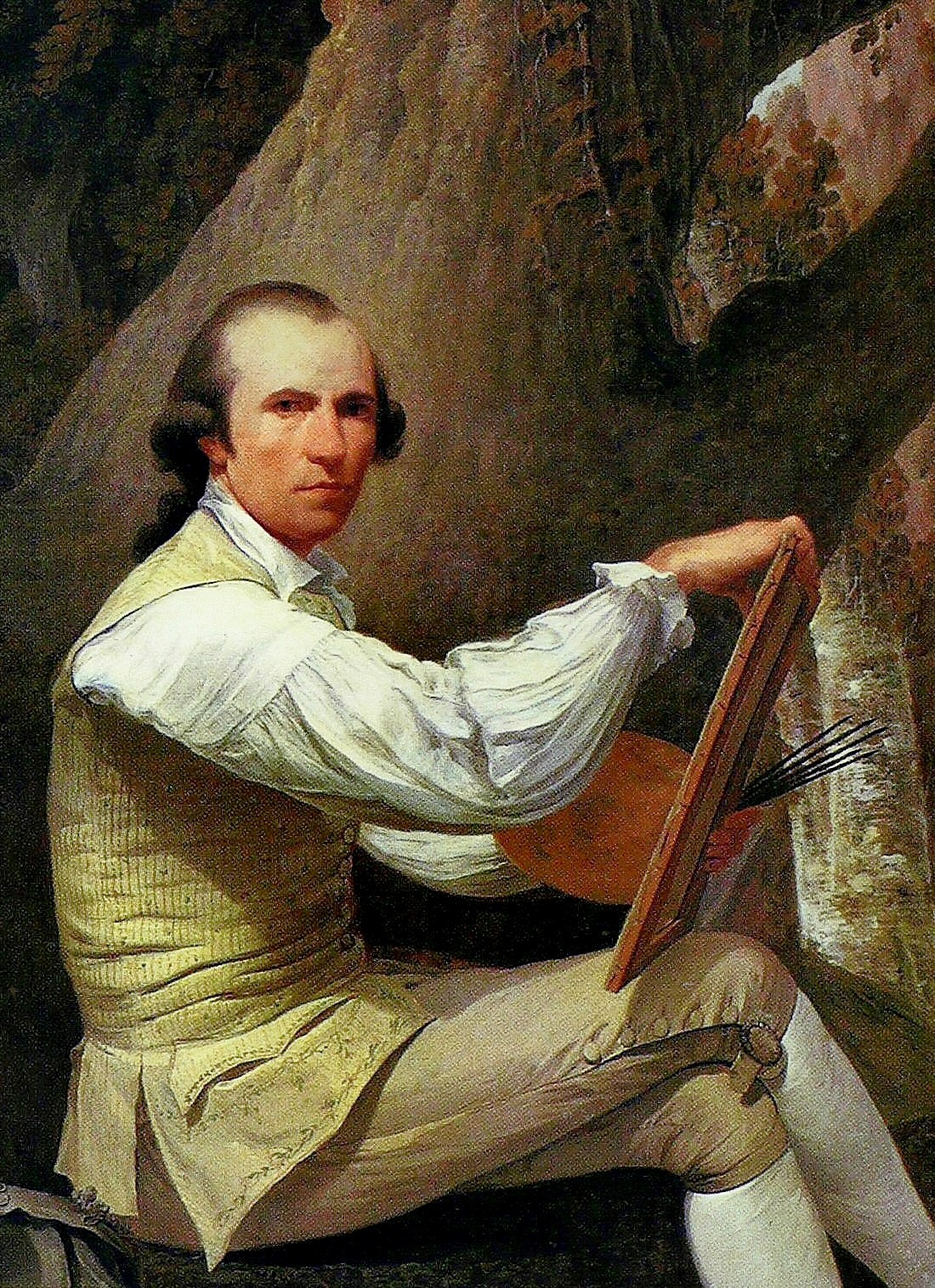
 ‘View of Lake Albano’ by Jacob More (1778) & Self-Portrait (1783)
Images courtesy of Christie’s & the Uffizi Gallery, Florence
When Jacob More made his Royal Academy debut in 1783, he was at the height of his artistic powers and commercial popularity. In recognition of this, the following year he was invited to join the pre-eminent painters to have self-portraits hung in the Uffizi Gallery in Florence. To have a one’s portrait displayed in the Vasari corridor would be one of the greatest honour of any artist’s career and tops any other distinction bestowed upon Jacob More. Painted especially for the occasion, More’s striking selfie – seated, sketching near the Falls of Tivoli – is testament to his enormous skill as a figural painter. Quite unlike anything else he ever painted, it still hangs today in the Uffizi alongside famous self-portraits of Rafael, Rubens, Reynolds, Reni, Velasquez, and Vigée-Le Brun.
In 1792, when war broke out between the French Republic and the Italian States the number of Northern European artists resident in Rome understandably began to dwindle and More too made the decision to leave. Ahead of his return to London he began working up what would be his most ambitious painting to date; a huge “panorama” of the Eternal City, commissioned by Prince Augustus, the Duke of Sussex. The painted panorama was, like the word itself, the recent invention of the Irish artist Robert Baker who was at that time drawing large crowds in Leicester Square to view his ‘Edinburgh from Carlton Hill’.
 An engraving of the Forum from the Capitoline Hill (circa 1846) and Jacob More’s annotated sketch for his Panorama of Rome showing the same view (circa 1792)
Images courtesy of the Fitzwilliam Museum, Cambridge
But before he could paint his great panorama Jacob More died in Rome on 1st October 1793. In its obituary ‘The Gentleman’s Magazine’ recorded his death, “At Rome, of a bilious fever, Mr. More, the ingenious and celebrated landscape-painter. This gentleman, so much esteemed for his professional abilities and private worth, was attended to the grave by all the English at Rome”.
Over the next century More’s Arcadian landscapes fell out of fashion, and his standing was diminished by Victorian art critics and even fellow artists, notably that old curmudgeon John Constable who could always be relied upon to disparage the work of other artists. Fortunately, in part due to prestigious exhibitions featuring his work at the National Gallery of Scotland, Tate Britain, and the Centro Internazionale a’Arte in Italy in 2001, Jacob More’s reputation as one of the 18th century’s most popular topographical painters is now being restored.
He was, after all, the first Scottish artist to dedicate himself entirely to landscape painting and although these days Alexander Nasmyth is widely regarded as “the Father of Scottish Landscape Painting”, and (in an especially unfortunate error) incorrectly credited as being More’s teacher by, of all places, the website of the National Galleries of Scotland, in truth that title really belongs to Jacob More.
Today, works by Jacob More are to be found in Tate Britain in London, the Uffizi Gallery in Florence, the Borghese Gallery in Rome, the National Gallery of Scotland in Edinburgh, the Art Gallery of South Australia, and the Fitzwilliam Museum of Cambridge University.
by Gavin Claxton
© Academy Fine Paintings Ltd 2026