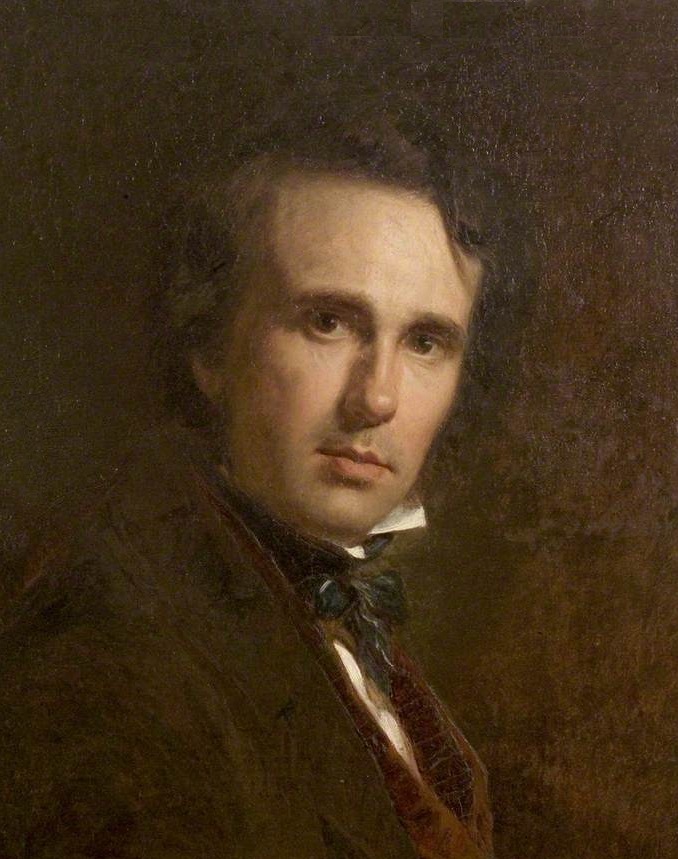
Like the gifted 19th century English landscape painters of the Pether family, the artist Henry Dawson (1811-1878) was also an inventor and a musician who fought throughout his life to overcome the many disadvantages of his working-class background and establish himself as one of the finest landscape painters in Victorian Britain.
Henry Dawson grew up in Nottingham in the East Midlands of England, but his childhood was brief. When his father’s business collapsed (and the man himself also began to fail, not least in his duties as a parent) the running of the family was left to his wife alone. Aged just 9, her precociously talented son was forced to abandon his education and go to work, initially “making rope” but, in fact, this would almost certainly have meant picking oakum, an arduous and injurious job typically performed by paupers. No doubt thanks to his obvious intelligence, industry, and dexterity the (very) young Dawson subsequently found work in the city’s lace making industry, becaming the household’s principal wage earner.
This at least afforded him the chance to paint in what spare time there was, and he sold small oils and watercolours for half-a-crown each to local shopkeepers and publicans. Dawson’s time in the factory also stimulated his gift for invention. Finding the lacemaking process unnecessarily laborious he developed a prototype for a machine that would speed-up production, but a lack of funds prevented him from securing the patent. Within a year a similar contraption with financial backing pipped Dawson’s invention to the post and went on to make another man’s fortune.

‘King’s Mill, Castle Donington’ (detail) by Henry Dawson
Image courtesy of Nottingham Museums
Throughout this difficult early period Dawson’s artistic ambitions were always supported by his mother, and by a pair of enthusiastic local art connoisseurs. The first was Thomas Bailey – retired hosier, wine merchant, politician, author and historian – who allowed the young Henry Dawson to study and make copies from his collection of engravings and Old Master paintings. Bailey and his son, the poet Philip James Bailey, lived at a manor house in the Nottingham suburb of Basford, by the sounds of it a most convivial and conducive home, that was also visited during the same period by another young wannabe artist – Andrew MacCallum – who would go on to even greater eminence and success as one of England’s finest landscape painters.
Henry Dawson’s second early advocate was a barber by trade, but – when he wasn’t shaving whiskers or handing out dubious medical advice, Joseph Roberts indulged his love of the arts as a part time picture dealer. In addition to being one of Dawson’s earliest admirers and patrons, Roberts would later play an important role in the artist’s later success.
In the summer of 1838 Henry Dawson made his debut at the Royal Academy in London and it was whilst visiting the capital that he took the opportunity of furthering his artistic apprenticeship. The twelve lessons he managed to squeeze in to his stay in London would count for little with most young artists, but Henry Dawson was no ordinary student, and the lessons were with no ordinary teacher. James Baker Pyne, like his friend and mentor Francis Danby, was a native of Bristol and a painter of dreamy English and continental river landscapes.
Although his time tutoring Henry Dawson was brief, I have no doubt it was useful and full of tips and technical insights that enabled incremental improvements in his pupil’s work. Certainly, over the following years, Dawson’s colour palette became bolder, and his already meticulous technique was augmented by a growing confidence and a flair for the dramatic which would eventually emulate that of J.B. Pyne’s beau idéal, J.M.W. Turner.

‘The River Thames looking towards St. Paul’s’ (1874) by Henry Dawson
Image courtesy of Bonhams, London
Three years later, Henry Dawson’s only remaining tie to Nottingham was broken when his mother passed away and he took the opportunity to move his young family to a city that would afford him the chance of finding wealthier clients and a dealer of higher standing. Rather than following the established path (taken by so many young provincial painters) to London, Henry Dawson travelled north to Liverpool, a city in which he had already exhibited; at an important art institution that had been defying the primacy of the London venues for decades. The Liverpool Academy of Arts was dedicated to improving the technical skills of local artists and to offering people living in the North of England an opportunity to see new and important works of art displayed in a single gallery space without having to travel to the capital.
The LAA reached its zenith in the 1840s; exhibition attendance figures hit record numbers, and prices achieved for exhibited works had never been higher. Its success was, in part, due to the increase in provincial patronage enabled by the Industrial Revolution. The flowering of the English School in Victorian Britain wasn’t financed by the aristocracy but by the self-made men of Merseyside, Manchester, Leeds, Huddersfield and Halifax, who by this time were the nation’s most enthusiastic (contemporary) art patrons, and Liverpool provided the North of England with an annual exhibition to be proud of.
Henry Dawson and the LAA were made for each other. It had always been keen to promote the work of really talented artists living “in the provinces” and Dawson painted precisely the sort of spectacular highly finished landscapes their newly-monied patrons – the self-made industrialists of the North – adored. And in many ways Dawson’s own industry, talent, and perseverance made him one of them.

‘The Thames near Runnymeade’ (1863) by Henry Dawson
Previously sold by Academy Fine Paintings
The sudden flurry of paintings the artist contributed to the Liverpool exhibition that year – of his native Nottinghamshire and particularly Sherwood Forest – garnered significant praise and caught the eye of art dealer Joseph Richardson. The steady stream of subsequent purchases made by Richardson dried up two years later when his business folded, but not before Dawson had found his first wealthy patron in the Scottish-born merchant and art collector John Miller who would later become one of the most important supporters of the Pre-Raphaelites.
In 1874, the artist’s Liverpool successes encouraged him to join the many British painters entering artwork in the national competition to decorate the newly rebuilt Palace of Westminster. The painting he presented was ‘King Charles I raising his Standard at Nottingham’, a superb and suitably grand picture that, although never hung in Parliament, is now the star attraction at Nottingham Castle Museum. Ironically, another of Dawson’s paintings did eventually become part of the Parliamentary Art Collection; ‘The New Palace of Westminster’ as seen from the south bank of the Thames is a sparkling picture and features one of his favourite weather features, crepuscular rays.

‘King Charles I raising his Standard at Nottingham’ (1847) and ‘The New Palace of Westminster’ (1867)
Images courtesy of the UK Parliamentary Collection & Nottingham Museums
Although Henry Dawson’s work was now regularly being selected by most of the major London venues – notably the British Institution, the Society of British Artists, and the Portland Gallery – he had yet to find regular favour with the hanging committee of the Royal Academy. During his four years living in Liverpool the artist had just one painting shown at the RA summer exhibition, a surprising statistic considering the quality of the pictures he would have been submitting.
For all the opportunities the city afforded Henry Dawson as an artist, he was also a husband and the father of two young sons, and Liverpool in the mid-19th century – cultural oasis though it strived to be – was also a city choking to death. Poor sanitation meant the water supply had become contaminated and pollution from the coal fires of steamships, factories, and the homes of its rapidly growing population filled the air with a smog of unburnt carbon and sulphur dioxide. It is these noxious atmospheric pollutants that filter moon and gaslight so attractively in the Liverpool pictures of John Atkinson Grimshaw, but in reality, their effect on Victorian cities looked very different.

Image courtesy of Tate Britain
In 1849, concerned for the health of his family and particularly for his two young sons Alfred and Henry Thomas (who would both go on to become successful artists in their own right), Henry Dawson took the decision to move his family to London. Bearing in mind his constant struggle for solvency it isn’t hard to imagine this presented many anxieties, but fortunately the one thing Henry Dawson never doubted was his own talent and the recognition and financial security it must inevitably bring.
Instead of the city itself the family settled in the suburbs, or rather what was then the rural market town of Croydon with its clean air, good water supply, and acres of open countryside. Biographies of Henry Dawson often view his first years in Croydon as being a struggle and certainly – apart from a consistent run at the British Institution – he wasn’t exhibiting regularly and the paintings that did make it onto the walls of the Royal Academy were poorly hung – or “skied” – closer to the ceiling than the eye line. However, his growing reputation among his fellow artists and, crucially, the capital’s picture-buying cognoscenti meant that he wasn’t relying on exhibition season to sell paintings. In the minds of those whose opinions “mattered”, Henry Dawson was the best kept artistic secret in England, and no doubt reluctant to encourage competition for his pictures his growing roster of private patrons were probably content to let that remain so.

‘The Royal Academy selecting pictures for Exhibition, 1875’ by Charles West Cope RA
Image courtesy of the Royal Academy Collection, London
Among Dawson’s admirers was John Burton, a Yorkshire mine owner and serious collector of contemporary British art. Upon his death in 1882 Burton’s bequest of 126 paintings laid the foundations for a permanent collection of art in York Museum which gives us a good idea of just how extensive and important his collection was. Shortly after the death of Turner in 1851, Burton wrote to Henry Dawson saying: “your powers are (now) not equalled by any living or working man”. And John Burton wasn’t the only super-fan of Turner who saw something special in Henry Dawson.
James Orrock had studied medicine at Edinburgh University, but it was as a watercolour painter and art collector that he would make his considerable reputation. By the 1860s Orrock was on his way to amassing one of the largest collections of contemporary art in England and the owner of several important works by – that man again – J.M.W. Turner. Significantly, ten years earlier Orrock had been living in Nottingham when he made the acquaintance of local barber Joseph Roberts, the same part time picture dealer who had purchased many of Henry Dawson’s early paintings. It was whilst visiting Roberts’ home that Orrock first saw Dawson’s work, an encounter that would leave a lasting impression.
Shortly after the Dawson’s arrived in Croydon, Orrock arranged to pay them a visit. Overwhelmed by the quality of paintings he found there he began discussing new commissions. Like most patrons he would naturally have requested that these feature his favourite subjects and reflect his personal taste. It is not unlikely that Orrock’s admiration for Turner further encouraged Dawson’s own interest in, and emulation of, the Great Man’s lighting effects in his dramatic sea pieces and sublime river landscapes; not only would this have been what his client wanted, but also what Dawson was so very good at painting.
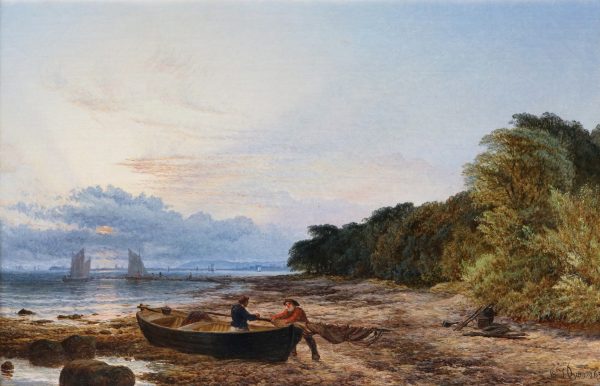
‘Crepuscular Rays’ (1863) by Henry Dawson
Now available at Academy Fine Paintings
It is from this period that ‘Crepuscular Rays’ comes. Painted in 1862, it depicts a shoreline on the south coast of England at twilight, beams of sunlight fan out from behind distant clouds as two fisherman launch a skiff from the beach in the foreground. The painting is now available to view at our Gallery page.
It was partly due to the high-profile patronage of John Burton and James Orrock that the penny finally began to drop with the wider art-buying public and the London critics. Demand for Henry Dawson’s paintings suddenly skyrocketed with prices increasing ten-fold. The sale of just two pictures in 1867 alone enabled Dawson to upscale, moving his family to a fine home in the elegant environs of Chiswick in what is now West London. ‘The Cedars’ would be the family home until the end of Henry Dawson’s life, and where he would come close to achieving something that at one time would have seemed impossible.

‘Crepuscular Rays’ (detail)
Then, as now, associate membership of the Royal Academy was awarded to those artists whose work was deemed to be of particular distinction and who might go on to join the first rank of British artists as a full Royal Academician. In 1866, the RA made a change to its laws to enlarge the number of Associate Members which immediately resulted in an increase in nominations. Only the members – the Royal Academicians – had the right to nominate new ARAs and to then vote in the election. Henry Dawson wasn’t without support among the RAs and in early 1867 his name was officially put forward for associate membership.
His principal sponsors were the Scottish painter of Spanish subject pictures, John Phillip and the Birmingham landscape painter, Thomas Creswick. Unfortunately, by the time election night came around in November, John Phillip had passed away and Creswick was too ill to attend the vote. The two new ARAs elected that evening were the versatile history painter Edward Armitage and Eyre Crowe, a very competent painter of well-meaning but rather forgettable subject pictures. Support for Dawson was never likely to match that for these well-connected gentleman and, as it turned out, he received just one vote, from the animal painter Richard Ansdell.
This wouldn’t be the last time Henry Dawson was nominated for ARA but on each occasion his name was not selected, evidently his face never did fit. Associate membership of the Academy would have been a useful accolade, but it would hardly make or break his career either way. Afterall, John Linnell – the most successful painter in Britain after Turner – had been (scandalously) overlooked for years.
 The East Wing of the National Gallery in Trafalgar Square, home of the Royal Academy until 1868
Images courtesy of the Royal Academy of Arts, London
Henry Dawson faced a far more damaging setback in 1871 when he was struck down by a long illness that threatened to prematurely end his career. Over the next few years, although he exhibited on four more occasions at the Royal Academy, his productivity slowed dramatically. Despite only ever submitting a relatively small number of paintings to the Suffolk Street Gallery in London, in 1875, the RA’s great rival institution showed its appreciation of Henry Dawson by electing him a full member of the Royal Society of British Artists.
Three years later he was further honoured with an exhibition of 57 of his paintings at the opening of the new Nottingham Castle Art Gallery. Organised by James Orrock, the event was attended by the Prince of Wales (the future King Edward VII) who was reported to have greatly admired the paintings and to have met and congratulated Henry Dawson himself. Later that same year a selection of the artist’s work formed part of the British Art section of the Jubilee Exhibition in Manchester where, in the words of the Dictionary of National Biography, “Dawson’s place among the greater masters of the English School was fully and publicly recognised”.
This somewhat belated recognition at least came in time. Henry Dawson died at home in Chiswick in December 1878, aged 67. Over the next century, like most artists, his popularity waxed and waned but in the past few decades his enormous talent has been recognised once again, and in 2000 his painting of ‘The New Houses of Parliament, Westminster, of 1857’ sold at Phillips in London for £185,000.
Today, Henry Dawson’s work can be found in the Victoria and Albert Museum, the Palace of Westminster, the Bank of England Museum, the Walker Gallery and the Lady Lever Gallery in Liverpool, Birmingham Museum, Manchester Art Gallery, the Ashmolean Museum of Oxford University, and the Yale Centre for British Art in Connecticut.
by Gavin Claxton
© Academy Fine Paintings 2025