
No family name in the history of British landscape painting – not Crome, Danby, Linnell, Williams, Cole, or Dawson – is more eminent than that of Pether. Between 1780 to 1880 the atmospheric nightscapes of Abraham, Sebastian, and Henry Pether were amongst the very finest painted by any artist of the period.
Abraham Pether, the patriarch, was born in Chichester in 1756. Although, by the age of nine, he was considered a musical prodigy he also excelled in the sciences and in later life his experiments with electricity, mathematics, and astronomy would lead to the invention of numerous items from telescopes to pencils. Nevertheless, as a young man Abraham Pether’s greatest gift was as a painter. His early teacher was the city’s foremost topographical artist George Smith (1713-1776) and naturally his technique and composition echo in Pether’s subsequent career. But it was Pether’s uncle who provided him with his most important influence. William Pether (1731-1795) was England’s foremost mezzotint engraver and the friend and collaborator of Joseph Wright (1734-1797), and it was in this family connection to the nation’s greatest ever painter that Abraham Pether found lifelong inspiration, specifically in Wright’s tenebristic landscapes.
 ‘Cottage on Fire at Night’ by Joseph Wright (circa 1785)
Image courtesy of the Yale Centre for British Art
Like Wright, Abraham Pether became one of the finest exponents of chiaroscuro; the bold contrasting of light and shade used to convey drama and three-dimensional depth in a painting. His atmospheric topographical scenes captured at or after dusk and illuminated by competing light sources – typically the flames of a fire and the light of the moon – evoke in the viewer a sense of awe at both the beautiful and the sublime.
 ‘Fire & Moonlight’ by Abraham Pether (circa 1785)
Previously with Academy Fine Paintings
Unfortunately for ‘Moonlight Pether’ (as he became known) critical success was not sufficient to safeguard the financial stability of his family and when he died after years of ill health his wife and children were left penniless. It is all too easy to forget that before the advent of the Welfare State and National Health Service there were no safety nets and whole families could quickly fall into destitution. In its obituary, the most important arts journal of the day, The Examiner, wrote…
“As a landscape painter, his abilities are universally known, particularly in effects of fire and moon-light. The peculiar softness of his distances, and the brilliancy of his afternoon scenes, conferred on him the appellation of the British Claude (Lorrain). His loss will be greatly regretted by an extensive circle of friends; but more especially by a widow and nine children, seven of whom are left totally unprovided for.”
Abraham Pether exhibited at all the major London venues between 1773 and 1811, including the Royal Academy on 61 occasions.
The elder of Abraham’s two gifted sons, Sebastian, was also a painter of moonlit nightscapes. A portion of these were not the representational English and Italian views of his father but capricci; imaginary topographical and architectural fantasies of tumbledown riverside priories captured under a full moon. Not unlike the melancholy ruined abbey paintings of Caspar David Friedrich, Sebastian Pether’s phantasmagorical pictures appealed to the coeval appetite for dark romantic fiction. Horace Walpole’s 1764 novel ‘The Castle of Otranto’ and the later stories of Ann Radcliffe, William Beckford, Lord Byron and Mary Shelley created a demand for haunting Gothic tales, and Sebastian Pether provided the pictures to go with them.
Despite his popularity with Regency and early Victorian audiences, like his father before him, Sebastian repeatedly fell into debt during his lifetime and with fifteen children (!) to support he could never paint sufficient canvas’ to satisfy the demand from dealers who instead commissioned hordes of journeymen painters to churn out lookalikes and copies of his work, specifically his Gothic nightscapes.
Modern day biographies of Sebastian Pether (1793-1844) invariably assert that his paintings are characterized by their “greenish hue”, but this is untrue. Assuming that the picture in question is clean and its midnight blue sky not yellowed by a layer of old varnish no genuine Pether will present a “greenish hue”.
Certainly, colour palette can help establish the authenticity of a Pether painting but rather than being a shade of green the characteristic pigment is found in the blue spectrum. First synthesized in the early seventeen hundreds, Prussian blue was popularised by some of the world’s greatest nightscape painters – notably, the aforementioned Caspar David Friedrich and Joseph Wright – and no painting by a member of the Pether family will be without it.
 ‘Galleons by Moonlight’ by Sebastian Pether
Previously with Academy Fine Paintings
The professional trials and private tragedies encountered by Sebastian Pether outstripped even those of his father. Never a wealthy or even solvent man the emotional and financial worries that came with such a large family eventually took their toll. When Sebastian Pether died in 1844 aged 51 his obituary in Gentleman’s Magazine stated that…
“During the three last years of his life he lost three of his grown-up children by consumption; and since the demise of the father another son died at Westminster Hospital of lockjaw occasioned by an accident to the hand. A subscription has been opened to help his surviving family out of their terrible state of (financial) distress.”
Abraham’s younger son, Henry Pether (1800-1880), was also a scientist and inventor, but like his father and brother it was as a painter of what was now the family trademark – the moonlit nightscape – that would earn him his place in British art history. Henry Pether’s accomplished draftsmanship and attention to detail, his lighting effects in the halftones and accents (the darkest and lightest passages) and subtle colouring are all exceptional and every bit the equal of his father.
Despite travelling widely across Britain capturing wonderful views of Worcester, Portsmouth and Southampton, and the medieval castles of Walmer in Kent and Newark near Glasgow many of Henry Pether’s favourite locations are to be found along the course of the Thames. As a native Londoner he knew the banks of the river intimately from Marlow, Windsor and Twickenham in the west, to Chelsea, Westminster, and The City itself, out to Greenwich in the east. His other great inspiration was Venice, of which the artist painted a series of fabulous scenes capturing its famous landmarks under the obligatory full moon. Pether’s nightscapes are some of the most beautiful every painted of the city.
Although, unlike his father and elder brother, unburdened by hordes of children Henry Pether also faced periods of debt and destitution throughout his life. Bearing in mind all the medical and financial misfortunes that befell the Pether family it is remarkable that the work of Abraham, Sebastian, and Henry did not suffer. They clearly took enormous pride in every canvas they produced and resisted the temptation to make compromises and cut corners, unlike a certain other artist whom we will get to in a moment.
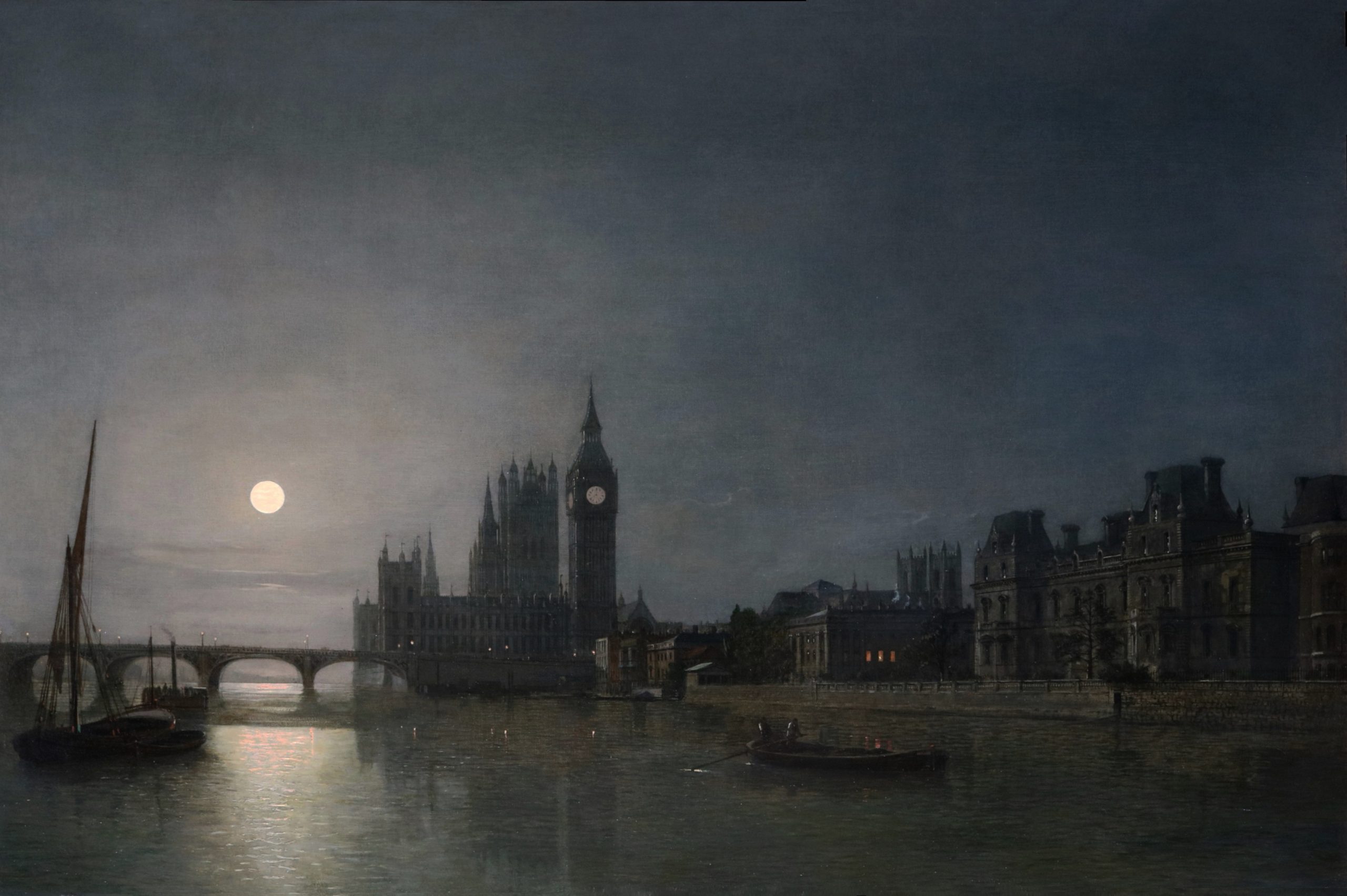 ‘Westminster from the Thames by Moonlight’ by Henry Pether
Currently available to purchase from Academy Fine Paintings
Unfortunately, a good many of the aforementioned 19th century Pether lookalikes – resembling production cels from a Scooby-Doo cartoon – remain in circulation today and are invariably attributed to one or other member of the Pether family. Consequently, people have come to associate these poor imitations with the name Pether, thus negatively affecting the family’s reputation and legacy by association.
I have no doubt that of the many people today who would claim to know the paintings of the Pether family comparatively few will have seen a real one. This presents a challenge for any dealer offering only the genuine article, but it is one worth accepting.
 A selection of counterfeit Pethers. Invariably these will be pseudo-Gothic capricci imitating Sebastian Pether
So, how can you tell if that 19th century moonlit nightscape being sold as a Pether is, in fact, a genuine Pether?
Firstly, ask yourself this; can you see what’s going on? In other words, are there passages that are so dark it is impossible to see what you are looking at? A genuine Pether will be easy to read and enjoy without the need for an Imalent flashlight.
Secondly, as I mentioned before, neither Abraham, Sebastian, nor Henry ever painted nightscapes in tones of bilious green, electric blue or mauve. These are all counterfeit.
Finally, if the painting in question is by Abraham or Henry Pether the subject will never be a fanciful fiction but an actual identifiable location. In Henry’s case this means somewhere near water, frequently London and the River Thames or other waterside vista exemplifying the picturesque.
Abraham and Henry Pether’s moonlit vedute (or “view” paintings) celebrate both the beauty of the natural world and the architectural achievements of humankind. In many ways Henry Pether is to the 19th century English edifice and waterway what Canaletto is to the canals and palazzi of 18th century Venice. I would go as far to say that no artist to have set up an easel in London has more successfully captured its atmosphere and architecture than Henry Pether, and that includes the Venetian master.
 (left) ‘The Ducal Palace, Venice’ by Henry Pether & (right) ‘Westminster from the Thames’ by Canaletto
In the third quarter of the 19th century the nightscape was given a rebranding by the Anglo-American artist James Abbott MacNeill Whistler. Having knocked off a series of hastily painted blue/green oil sketches the ever-resourceful Whistler, keen to ensure that the ignorant public recognised them as revolutionary works of genius and not hastily painted blue/green oil sketches, took to calling his nightscapes of the River Thames “nocturnes”.
Originally a musical term describing a composition inspired by or evocative of night, the word was borrowed by Whistler to describe his crepuscular pictures in the hope of bestowing upon them the appearance of refinement and to give the impression that he had originated a new subgenre of landscape painting; a typically brazen fancy that would have amused Rembrandt, Godfried Schalcken, Joseph Wright, Vernet, Turner, and Caspar David Friedrich etc. who were all painting “nocturnes” before Whistler was even born.
Whistler is said to have also used it to describe the work of the man who is today considered Britain’s greatest painter of moonlit scenes John Atkinson Grimshaw. Although it pains me to repeat it Whistler is supposed to have said…“I considered myself the inventor of nocturnes until I saw Grimmy’s moonlit pictures.”
This quote, attributed to Whistler by the author Lionel Lambourne in his book ‘Victorian Painting’, is all kinds of nonsense. There was no inventor here. This was appropriation not invention. Whistler may have been the first to apply the word to describe the mood or tonality of an oil painting but neither he nor Grimshaw originated nightscapes, which is what his distinctly underwhelming pictures are.
 Three of Whistler’s “nocturnes” of the Thames, including ‘The Falling Rocket’ (right), subject of John Ruskin’s outrage and a ruinous court case.
In fact it’s hard to believe Whistler ever said such a silly thing, not least as he was not given to praising other painters. Were we to name the master of the 19th century nightscape rather than some non-existent inventor we could certainly suggest a more deserving candidate than the King of Colouring-in, John Atkinson Grimshaw.
The modern-day praise heaped upon “Grimmy” is quite bemusing. There is no doubt that he could paint and sometimes he actually did, but far too often the integrity of his paintings was fundamentally compromised by his eagerness to cut corners.
On the face of it Grimshaw and the Pethers shared much in common; each became famous for painting moonlit nightscapes and repeatedly fell into debt during their lifetime. However – unlike Abraham, Sebastian, and Henry Pether before him – when the bailiffs came calling upon Grimshaw he resorted to every shortcut he could to speed up production of his pictures. It’s worth pointing out that in his case he didn’t choose to do this to save his children from poverty but to maintain his own overspending and pay for the upkeep of his two enormous properties, Knostrop Hall and his “Castle by the Sea”.
Today, Grimshaw’s cheats are spun as innovations. Whole articles are written about his “interest in photography” and use of the camera obscura, but rarely do they mention the alarming number of his paintings that are nothing more than over-painted photographic prints. When he wasn’t colouring-in black and white photos Grimshaw would again circumnavigate the need to bother with preparatory sketches and under-drawing by tracing images of photographs projected onto canvas by pinhole camera. JAG Superfans would here point out that da Vinci himself is known to have used a camera obscura, but Grimshaw was no Leonardo and this was not the 15th century.

‘St. James’, London’ – an overpainted photograph – by John Atkinson Grimshaw, sold by Bonhams in 2017 for £50,000
But the Grimshaw spin machine continues unabated. The website of one of the world’s foremost fine art auction houses assures us that… “John Atkinson Grimshaw’s innovation was to apply Ruskin’s tenet of ‘truth-to-nature’ to scenes of Britain’s burgeoning industrial centres. Owing to his sensitive portrayal of the atmosphere and ‘feeling’ of urban life, he has been considered the artistic equivalent of Charles Dickens and Elizabeth Gaskell.”
I suppose if you can persuade someone to part with £50,000 for an over-painted photo then perhaps you can convince them of anything.
Although it is rather glossed-over today, during Grimshaw’s own lifetime many leading artists of the day were sceptical that his canvas’ could even be accurately described as paintings, which goes a long way to explaining why just five of his pictures were ever accepted for exhibition by the Royal Academy. The dubious practises of the Victorian art world’s potboiler par excellence paved the way for greater charlatans like Jan van Beers (1852-1927) whose extensive use of tracing (of photos) allowed him to eradicate the need for figural draftsmanship in the hope of passing himself off as the new Bouguereau. A thorough look at his pictures reveals the vast inconsistency to be found in his figural drawing between the images he traced and those he clearly attempted to sketch himself. Although suspicions were raised at the time van Beer’ ploy worked and to this day his creations are still sold by distinguished dealers in Europe and North America who invariably praise “the accuracy of his drawing”.
As I have already said, when John Atkinson Grimshaw really did bother to paint, he did it well. But with the best will in the world, he was no Abraham or Henry Pether. In future should anyone ever attempt to elevate the former over either of the later remember they might as well be saying, to employ a modern-day analogy; “Yeah, I like David Bowie, but I prefer Gary Numan.”
Between 1828 and 1865 Henry Pether exhibited at the Royal Academy, the British Institution, and the Royal Society of British Artists. Today, paintings by Henry Pether are held in the collections of Tate Britain, the City of London, Royal Museums Greenwich, and the Yale Center for British Art, New Haven, Connecticut.
by Gavin Claxton
© Academy Fine Paintings Ltd 2024
Additional images courtesy of Sotheby’s, Bonhams, Tate Britain, and Detroit Institute of Arts.